
I keep hearing two versions of the AI story.
In one, AI gives everyone a personal tutor, doctor, researcher, and software engineer. In the other, it takes our jobs, floods the internet with deception, and concentrates power in a handful of companies.
Both versions miss the important part.
AI is a capability. It is not a plan.
The technology may become extraordinarily useful, but usefulness does not tell us who will own it, who will benefit from it, or who will absorb the disruption it creates.
That is the real issue raised by Bill Gates in his essay A Turbulent AI Era—and the Critical Choices We Need to Make. His argument is not simply that AI will be powerful. It is that society is entering this transition without institutions designed to manage it.
I think he is right about the absence of a plan—even if some of his predictions deserve more skepticism.
This transition may move differently
It is tempting to compare AI with the personal computer, the internet, or industrial automation.
The comparison is useful, but incomplete.
Earlier technologies usually required new equipment, specialist training, and redesigned business processes. AI already runs on devices people own and communicates through ordinary language. A worker does not need to learn programming to ask a model to analyse a document, create a presentation, or explain a spreadsheet.
That removes a lot of friction from adoption.
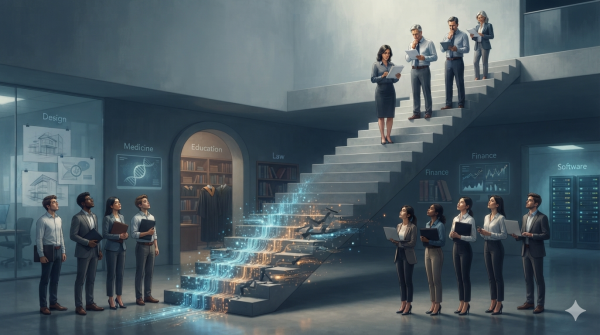
More importantly, AI is aimed directly at cognitive work. It can perform pieces of jobs in law, customer service, medicine, software development, finance, and education. Gates argues that this distinction could make the disruption broader and faster than previous technological transitions.
I would treat the proposed timeline cautiously. Demonstrating a task is not the same as performing a complete job reliably inside a real organisation. Accountability, integration, regulation, trust, and messy edge cases all slow adoption.
But we should not confuse those obstacles with permanent protection.
A system does not need to replace an entire profession to change its labour market. If ten people using AI can perform work that previously required fifteen, the technology has already changed hiring, bargaining power, and career progression.
Entry-level work worries me most. Those jobs often look inefficient because experienced employees can complete them quickly. But they are also how inexperienced employees become experienced. If companies automate the bottom of the career ladder, where will the next generation of senior workers come from?
What this means for my own work
This is not an abstract question for me. I work as a software engineer and cloud architect—two roles directly exposed to increasingly capable AI systems.
AI can already generate code, troubleshoot errors, explain unfamiliar repositories, draft infrastructure templates, and propose cloud architectures. Work that once took me hours can sometimes be completed in minutes.
That makes me more productive, but it also creates an uncomfortable question: if AI can perform more of these tasks, which parts of my experience will continue to matter?
I do not think the answer is simply to become better at writing prompts.
Generating code is only one part of engineering. The harder work is understanding why a system should exist, choosing between imperfect options, integrating it with existing environments, controlling cost, protecting data, and accepting responsibility when it fails.
Cloud architecture has the same distinction. Producing a diagram is easy. Understanding an organisation’s constraints is not. A technically elegant design may still be the wrong choice if the team cannot operate it, the migration risk is unacceptable, or its cost model does not survive real usage.
AI will improve at many of these tasks. I should not assume that judgment, architecture, or communication will remain permanently protected categories. But today, the most valuable work is shifting away from producing individual artefacts and toward owning outcomes across the whole system.
That changes how I think about my career.
I want to use AI aggressively for exploration, repetitive implementation, documentation, testing, and analysis. Refusing that leverage would not protect my skills; it would make them less relevant.
At the same time, I need to keep strengthening the capabilities that let me evaluate its output: software fundamentals, distributed-systems thinking, security, cost management, operational experience, and an understanding of the business problem behind the technology.
The choice is therefore not between using AI and competing against it.
My choice is whether I remain someone who mainly produces technical output, or become someone who can frame the problem, direct the tools, challenge their answers, and take responsibility for the result.
I believe this is the best way to adapt, but the technology is changing too quickly for anyone to promise that it will secure my future.
Work is more than a payment mechanism
Most discussions of automation eventually arrive at universal basic income, retraining, or shorter working weeks.
Those ideas may become necessary, but they address only part of the problem.
People do not experience a job purely as a monthly bank transfer. Work can provide structure, social contact, status, identity, and the feeling that someone needs what you know how to do.
This does not mean every existing job should be preserved forever. Many jobs are dangerous, exploitative, or painfully repetitive. We should happily automate some of them.
But “people will find something else” is not a transition policy.
Workers cannot instantly move between industries. A displaced construction worker may not want—or be able—to become an elder-care specialist. A junior designer cannot become a machine-learning engineer after completing a six-week online course.
The economic spreadsheet may call this reallocation. The person living through it experiences the loss of a career.
Some decisions should remain human
One of Gates’s more interesting ideas is a category he calls “Human Reserved”: work that machines might be capable of doing but that society deliberately chooses to leave under human control.
The obvious examples are deeply personal decisions: delivering a terminal diagnosis, caring for vulnerable people, judging a child’s welfare, or authorising lethal force.
I find the principle more useful than the label.
We already restrict technically possible actions when they conflict with values we consider more important. The question is whether efficiency should always win simply because an automated system becomes cheaper.
There is a danger here. “Human Reserved” could become an excuse to protect inefficient institutions or established professions. The boundary therefore cannot be set by incumbents alone.
It should depend on accountability, dignity, public consent, and the consequences of failure—not nostalgia for how work used to be done.
The first experience will shape everything
AI has genuine potential in healthcare, education, scientific research, agriculture, and public services. It could make expertise dramatically cheaper and more widely available. Gates is especially persuasive when he argues that these benefits must reach people who currently lack money, specialists, and institutional access.
But access will not happen automatically.
The market will naturally optimise for customers who can pay. It will not automatically build agricultural tools for small farmers, medical systems for understaffed clinics, or accessible services in languages with limited commercial value.
Those outcomes require deliberate investment.
They also matter politically. If someone’s first meaningful encounter with AI is better medical care or simpler access to government support, they may see it as useful infrastructure. If it is a rejected job application, an automated dismissal, or a convincing scam, they will see it as a threat.
Public trust will be shaped less by demonstrations of what AI can do than by people’s experience of what it does to them.
We need choices, not predictions
Gates proposes new coordinating institutions, stronger international cooperation, human-reserved work, and taxes on AI usage and robots to fund the transition.
These ideas are deliberately provocative, but they remain starting points.
A tax on AI tokens sounds simple until we ask whether a hospital, school, small business, and advertising platform should pay the same rate. A robot tax may slow harmful displacement, but it could also delay automation that makes dangerous work safer. International oversight is desirable, but competition between countries makes meaningful enforcement difficult.
The absence of easy answers is not a reason to postpone the discussion.
We should ask concrete questions now:
- Who is accountable when an AI system causes harm?
- Which decisions require meaningful human review?
- How will workers share in the productivity gains?
- Who funds retraining and transition support?
- How do smaller companies and poorer countries gain access without becoming permanently dependent on a few providers?
- And which parts of human life should never be optimised solely for cost?
AI will not answer these questions for us. Technology companies should not answer them alone either.
The future of AI will not be determined only by the intelligence of the models. It will be determined by the quality of the institutions, incentives, and boundaries we build around them.
The models are advancing quickly.
Our plan needs to catch up.

